How Amazon Uses Consumer Psychology


The Power of Effortless Decision-Making
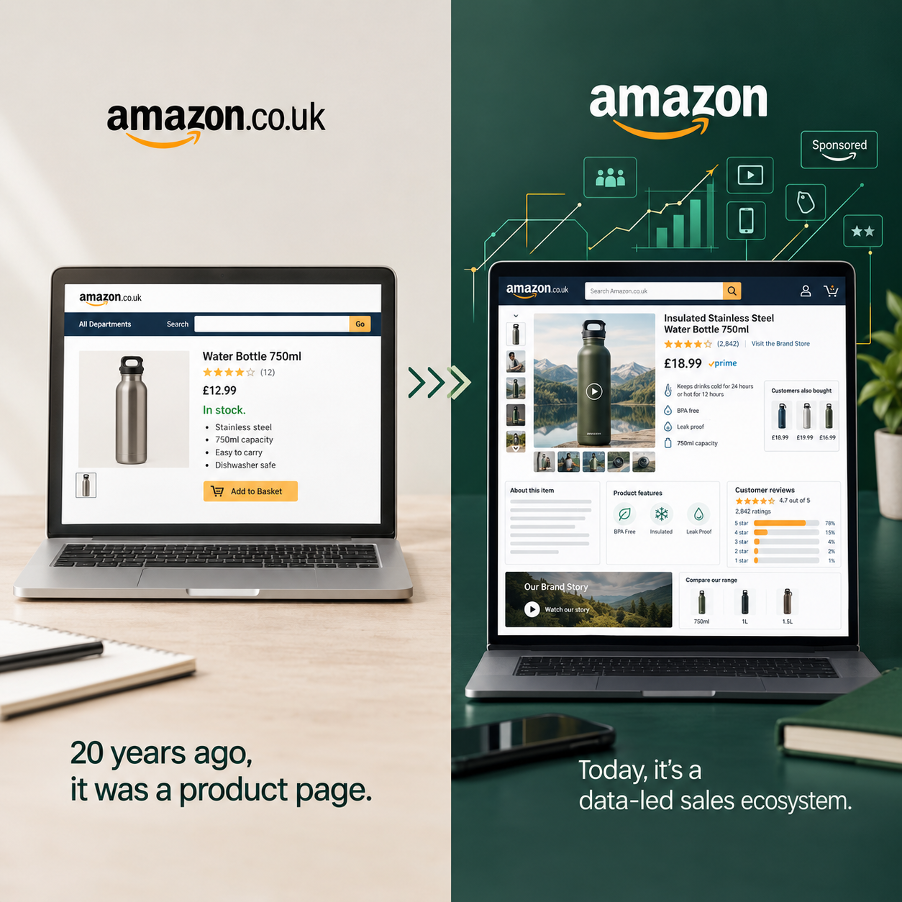
Amazon is no longer just an ecommerce platform. Today, it is a highly optimised shopping environment built upon a deep understanding of consumer psychology.
Every element of the customer’s journey is designed to reduce friction, simplify decision-making, and guide shoppers towards purchase.
Shoppers will naturally gravitate towards the choice that requires the least mental effort; a state known as cognitive ease, where the brain processes information intuitively rather than through slower, more analytical thinking. This occurs when information is repeated, clear, or familiar - fostering a feeling of trust and security.
Creative elements such as clear fonts and high-contrast imagery can help create this effect. Repeated exposure to information makes it easier to process cognitively, leading to an increased feeling of trust and familiarity.
When decisions feel simple, shoppers are more likely to convert.
Amazon helps reinforce this behaviour through inbuilt features designed to remove as much friction as possible at the point of purchase. One such feature is the ‘Buy It Now’ button, which allows consumers to bypass the basket and checkout immediately. This shortens the customer journey and limits opportunities for distraction or drop-off.
The ‘Subscribe and Save’ feature removes the need for repeated decision-making, increases retention and taps into habitual buying behaviour. This feature allows for maximum convenience, thus providing the least amount of mental effort compared to re-choosing an item at regular intervals.
Personalised product and ad recommendations utilise behavioural data to push the most relevant products to the individual shopper. By narrowing the field of choice, Amazon reduces decision fatigue and overwhelm, increasing the likelihood of conversion.
For brands, the implication is clear. Success on Amazon is not just about driving traffic, but about reducing friction at every stage of the customer journey. The easier you make it for shoppers to process information, build trust, and make a decision, the more likely they are to convert.
Minimising Decision Fatigue to Maximise Conversions
On Amazon, shoppers are presented with an almost unlimited number of choices. While this level of variety is undoubtedly one of Amazon’s strengths, it also introduces a challenge: decision fatigue.
Decision fatigue is a mental and emotional state of exhaustion caused by making too many decisions in a short period of time. This can lead to people making poorer choices than usual, impulsivity, or a total avoidance of decision-making. As cognitive energy depletes, the brain seeks shortcuts, often resulting in poorer decisions and increased stress.
The more options a consumer evaluates, the more mental effort is required of them. This makes it harder to make a final decision and in many cases, leads to delayed purchase or complete drop-off.
Amazon has streamlined its shopping experience to counteract this behaviour as much as possible by simplifying choice through psychological shortcuts. Trust signals and decision shortcuts embedded throughout the customer journey reduce the cognitive load required to evaluate products and enable faster, more confident decision-making.
The Role of Social Proof:
One of the most powerful tools Amazon has in its arsenal is customer reviews.
Reviews provide immediate social validation, allowing consumers to rely on the experiences of others rather than conducting their own extensive research. Surveys have found that 93% of consumers will read online reviews before purchasing anything, with 53% of consumers trusting reviews as much as a personal recommendation.
This is largely due to a psychological phenomenon called social proof, where people replicate the actions of others, especially in situations of uncertainty.
High ratings and detailed feedback reduce perceived risk and create a sense of reassurance, building trust and shortening the path to trust between the brand and the consumer.
Heuristics and Trust Signals:
Amazon also makes use of heuristics, or mental shortcuts, that help streamline decision-making, allowing for quick and efficient judgments to be made. Badges such as ‘Amazon’s Choice’ and ‘Best Seller’ act as clear indicators of popularity and reliability. Rather than comparing multiple products in detail, shoppers can use these cues to quickly identify options that are already performing well. This reduces the need for deeper evaluation, increases confidence in the decision, and reinforces the choice by leveraging social proof.
Reducing Cognitive Load Through Clarity:
Another key factor in minimising decision fatigue is how information is presented. Optimised, easy-to-scan product titles allow shoppers to quickly understand essential details such as size, function, key USPs and value. Clear, structured information reduces the effort required to interpret listings; making it easier to compare products and glean information quickly. This aligns with the principle of cognitive ease, where clear and easy-to-process information is more likely to be trusted and acted upon.
Understanding how Amazon reduces decision fatigue highlights a broader truth about the platform: success is not driven by offering more choice, but by making that choice easier.
In a marketplace defined by scale and competition, the brands that perform best are those that align with this environment, reduce cognitive load, build trust quickly, and simplify the path to purchase.
The Psychology of Relevance
A defining factor behind the success of Amazon is its ability to make the shopping experience feel highly personal and relevant to each individual user.
Given the sheer scale of choice presented, relevance plays a critical role in shaping how shoppers interact with products. Rather than forcing users to search extensively, Amazon brings the most relevant options to the surface, reducing effort and increasing the likelihood of engagement.
From a behavioural perspective, relevance reduces cognitive load and increases perceived value. When shoppers are presented with products that closely align with their intent, they don’t need to filter through less relevant alternatives; lowering the the mental effort needed to evaluate choices and allowing decisions to be made more quickly.
At the same time, relevant products feel inherently more valuable. When something closely matches a shopper’s needs or preferences, it is perceived as a better fit, increasing both engagement and conversion likelihood.
Personalisation and Familiarity:
One of the primary ways Amazon achieves relevance is through personalised product recommendations.
These recommendations are driven by behavioural data, including browsing history, past purchases, and search patterns. By analysing this data, Amazon is able to suggest products that match closely to a shopper’s previous actions. This creates a sense of familiarity, which plays an important role in decision-making; shoppers are more likely to engage with products that feel relevant or linked to their behaviour, as they require less effort to evaluate and trust.
Aligning with Shopper Intent:
Relevance is also achieved through targeted advertising placements. On Amazon, ads are not shown at random, they are placed in contextually relevant positions, such as within search results or alongside similar products. This ensures that the product is presented when the shopper is already demonstrating intent, so ads feel more like a natural continuation of their shopping journey rather than an interruption. This can increase the likelihood of engagement and conversion, as the product is perceived as both timely and appropriate.
Dynamic Search and Merchandising:
Another way Amazon makes itself feel relevant and personalised to users is through the use of dynamic search and merchandising. Search results and product placements are continuously refined based on user behaviour and performance signals, such as click-through rates and conversion data.
Products that perform well are more likely to be surfaced more prominently, creating a feedback loop which reinforces relevance. This ensures that shoppers are consistently shown products that are not only tailored and relevant to them, but are also proven to perform well with similar audiences.
The result is a shopping experience that feels increasingly tailored, efficient, and effective.