Amazon Listings Then vs Now: Why Brand Registry and Brand Bank Alone Are No Longer Enough

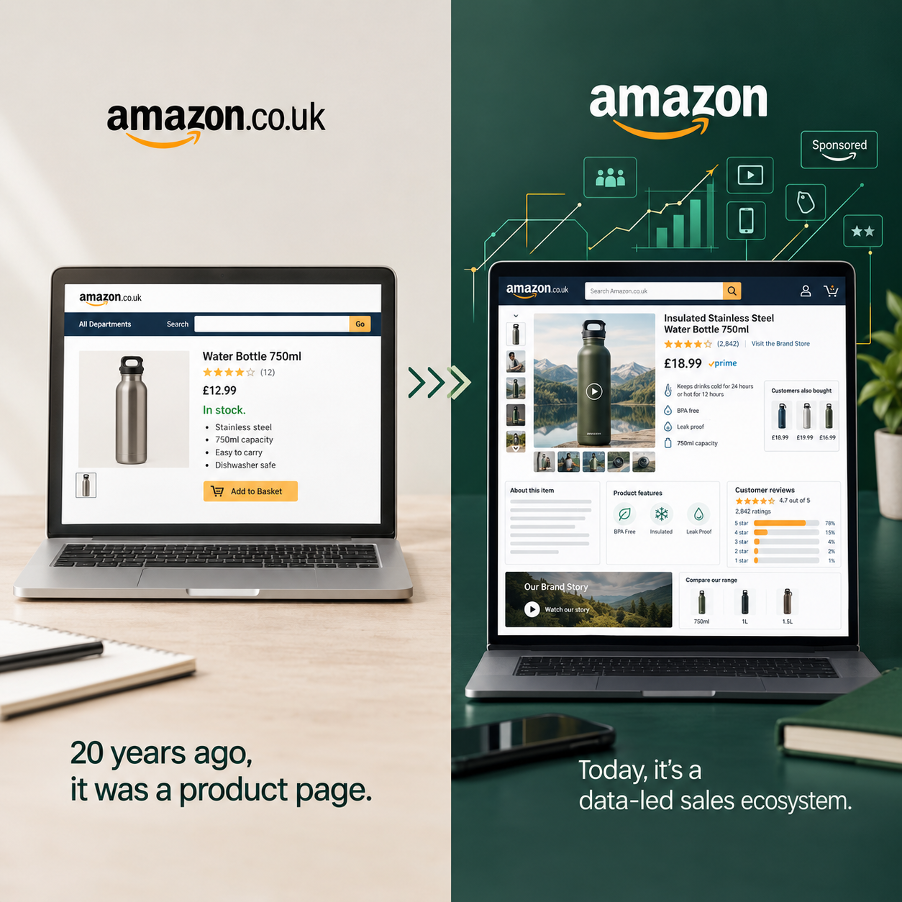
20 years ago, an Amazon listing was little more than a digital catalogue entry.
Today, it has become one of the most sophisticated retail, advertising and conversion assets in commerce.
Many brands have recognised this evolution and invested in Amazon Brand Registry, A+ Content and Storefronts. However, one of the biggest misconceptions we still encounter is the belief that gaining control of content through Brand Registry automatically creates commercial success.
It doesn't.
In 2026, winning on Amazon requires much more than simply populating a listing with brand-approved content. Success comes from building product pages specifically for Amazon's increasingly AI-driven, data-led sales ecosystem.
Amazon Listings in 2006: The Catalogue Era
Twenty years ago, most Amazon.co.uk listings consisted of:
A product title
One or two images
A short product description
Basic specifications
A price
Availability
For many brands, visibility depended largely on availability, pricing and whether customers were already searching for that product or brand.
The listing itself was rarely a significant differentiator.
The majority of FMCG, grocery and consumer brands treated Amazon much like any other retailer. Product information was often copied directly from packaging or retailer databases.
Simply being listed was often enough.
Amazon Listings in 2026: The Sales Ecosystem Era
Today's Amazon listing performs the role of:
Shop window
Salesperson
Product demonstration
Search engine result
Advertising landing page
Brand experience
Customer service tool
Every element influences performance.
Modern listings include:
SEO-optimised titles
Search-focused bullet points
Detailed product attributes
Enhanced image stacks
Product videos
Brand Story modules
A+ Content
Premium A+ Content
Product comparison tables
Review ecosystems
AI-powered recommendation signals
Amazon itself states that A+ Content can increase sales by between 3% and 10%, while Premium A+ Content can drive lifts of up to 20% when implemented effectively.
That means content is no longer a cosmetic exercise.
It is a commercial asset with measurable revenue impact.
The Rise of Vendor and Seller Central Brand Building
Historically, Amazon Vendors focused heavily on retail metrics:
Purchase Orders
Service levels
Availability
Cost prices
Meanwhile, Seller Central brands concentrated on:
Listings
Buy Box ownership
PPC advertising
Today, the distinction has blurred.
Whether operating through Vendor Central or Seller Central, leading brands recognise that content quality directly influences:
Organic ranking
Conversion rates
Advertising efficiency
Retail readiness
Customer trust
Long-term profitability
For example:
Grocery and FMCG
Twenty years ago, a cereal, snack or peanut butter listing might simply display a front-pack image and ingredients.
Today, successful grocery listings often utilise:
Lifestyle imagery
Usage occasions
Nutritional infographics
Sustainability messaging
Product comparison tables
Cross-selling opportunities
Brands such as premium coffee, snack and wellness businesses increasingly use A+ Content to explain provenance, ingredients, certifications and brand purpose, helping justify premium pricing.
Consumer Electronics
Brands like air treatment, kitchen appliance and home comfort manufacturers now deploy:
Video demonstrations
Premium A+ modules
Interactive feature explanations
Product family comparison charts
The product page has effectively become the digital equivalent of an in-store demonstration.
Beauty and Personal Care
Modern beauty brands invest heavily in:
Before-and-after visuals
Ingredient storytelling
Brand Story modules
Educational content
Routine-building cross-sells
Many of the fastest-growing brands now treat Amazon product pages similarly to dedicated landing pages.
Why Brand Registry Is Not a Strategy
One of the most common mistakes we see is:
"We've connected to Brand Registry and uploaded A+ Content, so our listings are optimised."
Unfortunately, that's rarely true.
Brand Registry simply provides tools.
The real challenge is deciding how to use them.
Many brands still upload:
Generic marketing copy
Packaging text
Retailer descriptions
Corporate brand messaging
without considering how Amazon customers actually browse, search and buy.
Amazon listings need to be designed for:
The Customer
Can they quickly understand:
What the product does?
Why it is different?
Why they should trust it?
Why they should buy now?
Amazon's Algorithms
Can Amazon clearly understand:
Relevance
Use cases
Product attributes
Category placement
Advertising eligibility
Amazon's AI-Driven Future
Amazon's search experience continues to evolve through AI-powered shopping tools, recommendation engines and richer product discovery experiences.
This means content is becoming increasingly important not only for customers but also for helping Amazon understand product relevance and context.
The brands that provide the richest, most accurate and most complete product data are likely to be best positioned as these systems continue to develop.
A+ Content, Brand Story and Premium A+ Are Only Valuable If Used Properly
Many brands view A+ Content as a design project.
The most successful brands view it as a conversion project.
Good A+ Content:
✅ Answers customer objections
✅ Improves understanding
✅ Reinforces trust
✅ Supports SEO and discoverability
✅ Reduces purchase hesitation
✅ Increases conversion
Great Amazon content isn't written by a marketing department in isolation.
It's informed by:
Search term data
Voice-of-customer insights
Review analysis
Competitive benchmarking
Conversion metrics
Advertising performance
Category-specific shopper behaviour
The Future Belongs to Data-Led Content
The biggest evolution over the last 20 years isn't the introduction of better images, videos or A+ Content.
It's the shift from catalogue management to performance management.
Amazon content is no longer simply about making a product page look attractive.
It is about using data to create product pages that:
Rank better
Convert better
Advertise better
Scale better
The brands winning on Amazon are increasingly those that treat content as an ongoing optimisation process rather than a one-time project.
How 17Verde Helps Brands Win
At 17VERDE, we don't believe in simply connecting brands to Brand Registry and filling in content modules.
We help brands build Amazon-native content strategies that combine:
Vendor Central expertise
Seller Central expertise
Search behaviour analysis
Retail analytics
Advertising insights
Conversion optimisation
A+ Content strategy
Premium A+ implementation
Brand Story development
Our approach is simple:
Every word, image, attribute and module should contribute towards discoverability, conversion and growth.
Because in 2026, the brands that win on Amazon aren't necessarily those with the best products.
They're often the brands whose content helps Amazon and customers understand those products best.
If your Amazon listings still look like a retailer product catalogue rather than a performance-driven sales asset, we'd love to show you what's possible.
👉 Contact 17VERDE for a listing performance review and discover how much growth could be hidden within your existing catalogue.


